

Devotional Biology
-
What You Need Before Starting This Class3 Steps
-
Lesson 1: Introduction and Biology for the Believer, Part 18 Steps
-
Meet Dr. Kurt Wise (4 min video)
-
0.1 - Contrasting Two Worldviews (28 min video)
-
Read Introduction - Why This Biology Class is Unique
-
🔬 Read Lab Manual: Introduction to Labs
-
1.1 - God Desires to Be Known (25 min video)
-
Read Chapter 1.1: Creation and Revelation
-
1.2 - Christian Foundation of Science and Biology (28 min video)
-
Read Chapter 1.2: The Origin of Modern Science
-
Meet Dr. Kurt Wise (4 min video)
-
Lesson 2: Biology for the Believer, Part 25 Steps
-
Lesson 3: Biology for the Believer, Part 35 Steps
-
Lesson 4: The Living God, Part 19 Steps
-
2.1 - Divine Through Animal Life (18 min video)
-
Read Chapter 2.1: The Living God
-
2.2 - Are Plants Alive? (17 min video)
-
Read Chapter 2.2: Biblical Life
-
2.3 - The Spectrum of Perfection of Life (13 min video)
-
Read Chapter 2.3: The Spectrum of Perfection of Life
-
2.4 - The Nature of Life (15 min video)
-
Read Chapter 2.4: The Nature of Life
-
Perform Lab Exercise 2: The Nature of Life (90 minutes)
-
2.1 - Divine Through Animal Life (18 min video)
-
Lesson 5: The Living God, Part 25 Steps
-
Lesson 6: The Glory of God6 Steps
-
Lesson 7: God is Distinct, Part 16 Steps
-
Lesson 8: God is Distinct, Part 23 Steps
-
Lesson 9: God is Good, Part 18 Steps
-
5.1 – Mutualism (27 min video)
-
Read Chapter 5.1: God is Good
-
5.2 - Curse (21 min video)
-
Read Chapter 5.2: Biological Evil
-
5.3 - Biological Evil (23 min video)
-
Read Chapter 5.3: Negative Effects of the Curse
-
5.4 - Our Responsibility to Biological Good & Evil (26 min video)
-
Read Chapter 5.4: Goodness of the Creation
-
5.1 – Mutualism (27 min video)
-
Lesson 10: God is Good, Part 22 Steps
-
Lesson 11: God is Person, Part 16 Steps
-
Lesson 12: God is Person, Part 28 Steps
-
6.4 - Animal Intelligence (26 min video)
-
Read Chapter 6.4: Biological Intelligence Continued
-
6.5 - Animal Will (27 min video)
-
Read Chapter 6.5: Organismal Will
-
6.6 - Animal Personality (35 min video)
-
Read Chapter 6.6: Biological Emotions
-
6.7 - The Origin of & Responsibility to Personhood (22 min video)
-
Read Chapter 6.7: The Origin of Personality
-
6.4 - Animal Intelligence (26 min video)
-
Lesson 13: God is Person, Part 34 Steps
-
Lesson 14: God is Person, Part 42 Steps
-
Lesson 15: God is Love, Part 16 Steps
-
7.1 - The Anthropic Principle & the Earth (25 min video)
-
Read Chapter 7.1: God is Love
-
7.2 - The Anthropic Principle & the Solar System (25 min video)
-
Read Chapter 7.2: Solar System Structure
-
7.3 - The Anthropic Principle & Atoms (29 min video)
-
Read Chapter 7.3: Necessary Small-Scale AP Characteristics
-
7.1 - The Anthropic Principle & the Earth (25 min video)
-
Lesson 16: God is Love, Part 25 Steps
-
Lesson 17: The Sustaining God, Part 16 Steps
-
Lesson 18: The Sustaining God, Part 22 Steps
-
Lesson 19: God is One, Part 16 Steps
-
Lesson 20: God is One, Part 22 Steps
-
Lesson 21: God is Three11 Steps
-
10.1 - Climatic Variety (14 min video)
-
Read Chapter 10.1: Three Persons
-
10.2 - Land Biome Variety (14 min video)
-
Read Chapter 10.2: Land Biome Variety
-
10.3 - Water Biome Variety (15 min video)
-
Read Chapter 10.3: Water Biome Variety
-
10.4 - Biodiversity (20 min video)
-
Read Chapter 10.4: Biodiversity
-
10.5 - Responsibility to Biodiversity (17 min video)
-
Read Chapter 10.5: Diversity: Our Responsibility
-
Test - Chapter 10
-
10.1 - Climatic Variety (14 min video)
-
Lesson 22: God of Hierarchy, Part 16 Steps
-
Lesson 23: God of Hierarchy, Part 25 Steps
-
Lesson 24: God of Hierarchy, Part 32 Steps
-
Lesson 25: The Almighty God, Part 16 Steps
-
Lesson 26: The Almighty God, part 22 Steps
-
Lesson 27: God the Word, Part 16 Steps
-
Lesson 28: God the Word, Part 22 Steps
-
Lesson 29: Fullness of God, Part 16 Steps
-
Lesson 30: Fullness of God, Part 23 Steps
-
Lesson 31: Fullness of God, Part 32 Steps
-
Lesson 32: History of Life9 Steps
-
15.1 - Biblical Chronology (26 min video)
-
Read Chapter 15.1: The Communicating God
-
15.2 - The Creation Week (18 min video)
-
Read Chapter 15.2: Creation Week
-
15.3 - The Edenian and Ante-Diluvian Worlds (21 min video)
-
Read Chapter 15.3: The Edenian Epoch
-
15.4 - The Flood & Arphaxadian Epoch (26 min video)
-
Read Chapter 15.4: Arphaxadian Epoch
-
Test - Chapter 15
-
15.1 - Biblical Chronology (26 min video)
-
Optional Lesson 33: Appendix on Evolution4 Steps
Read Chapter 2.3: The Spectrum of Perfection of Life

Why are there so many different kinds of life? If there is only one God, and He wanted us to understand the invisible attribute of life, why did He provide more than one physical illustration of life? Part of the answer probably has something to do with the fact that there is more than one person of the Godhead (see Chapter 8). But another reason is that God wanted us to know more than the simple fact that God has the attribute of life.
God also wanted us to understand that He has infinite life. The finite brains of humans cannot fully comprehend anything that is infinite. So how does God teach a finite being that He possesses an infinite measure of a particular trait? Besides making the claim in His word, I suggest that God has created both the creation and the human mind in such a way that humans automatically conclude that God possesses an infinite or unlimited measure of a particular trait.
I suggest that God endowed different parts of His creation with a suite or spectrum of different degrees or perfections of the trait in question. Some things in the creation lack the trait entirely. Other things have only a miniscule measure of the trait. Other things have the trait in small measure, others still possess intermediate amounts of the trait, and still others possess the trait in large measure.
In Figure 2.2, the four circles represent four different examples of a given trait in the creation. The smallest circle represents something with a miniscule measure of that trait, the next circle something with a small measure, the next circle something with an intermediate measure, and the largest circle something with a large measure of that trait. It is a human tendency to arrange the circles in order of increasing size and then (with the dashed lines) extrapolate from what is seen towards a circle of unlimited or infinite diameter.
When the different measures of the trait found in different objects are arranged in order (from objects lacking the trait to objects having the trait in large measure), what results is a spectrum of perfection of the trait. At the same time, I suggest that God endowed humans with three automatic responses to this spectrum of perfection: 1) a tendency to recognize the different perfections in the creation; 2) a compulsion to order these different perfections into a spectrum; and 3) a tendency to extrapolate the spectrum beyond what is observed. Each occurrence of the trait in the creation provides an illustration to help us understand the trait. The spectrum of perfection of that trait causes us to extrapolate beyond what is actually observed towards an unlimited or infinite manifestation of that trait.
If humans possess some measure of the trait along the spectrum (as represented by the stick figure in the third circle), then humans also conclude that whatever possesses the trait is very much greater than humans. This spectrum of perfection aids our minds to envision an infinite form of that trait. Though we will never fully comprehend such an infinity, our minds are lifted in that direction.
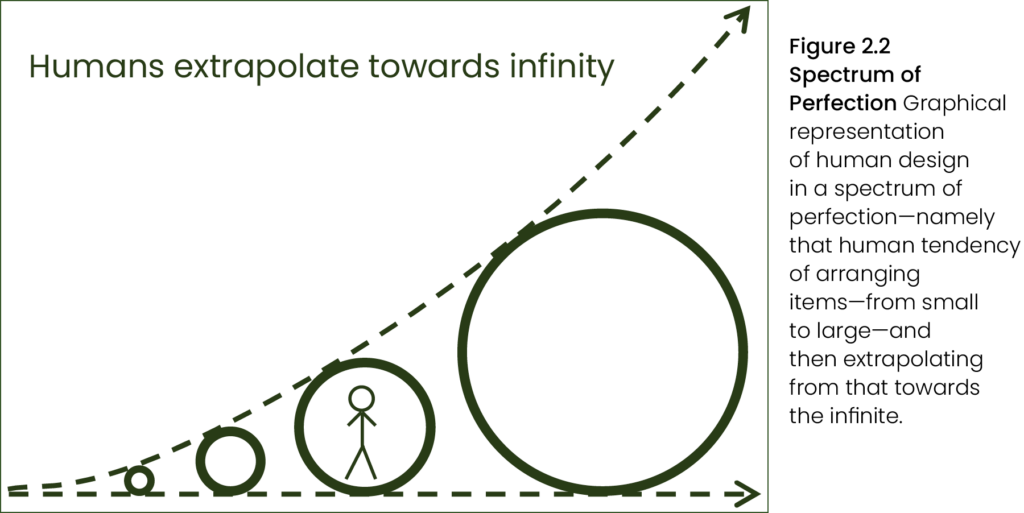
In the case of life, there are objects in the universe that lack life altogether. Such things as stars, planets, moons, and the substances of which they are made do not seem to possess life at all (represented by the intersection of the dashed lines on the left side of Figure 2.2). A whole suite of other things (bacteria, protozoa, algae, fungi, and plants) have so many physical attributes of life that they are considered alive even when they are not considered living in Scripture (represented by the smallest circle in Figure 2.2).
God even created some things between non-living things and biological life. Viruses have DNA (or the very similar RNA) but they are not made of cells and they can only do the other things characteristic of life by taking over the cells of organisms. So, there is a spectrum of perfection of life from non-living things, to viruses, to biologically living things. There is also a sense in which this spectrum can be continued among the biologically living things. An animal seems to be able to experience a fuller or more perfect life than a plant (represented by the second circle from the left in Figure 2.2). And, though the cells that make up the bodies of plants or animals or humans are living, such cells seem to possess a less perfect form or manifestation of life than the organisms they make up.
Even the same organism in different stages of development or different states of health seems to possess life in more or less perfect forms. A newly fertilized human egg appears to us to be less vibrant and active (‘alive’) than a swimmer during an Olympic event. A person in a coma shows fewer evidences of ‘life’ than a child laughing in the midst of play. A human, who has the capacity to know God has a more perfect form or manifestation of life than an animal (represented by the third circle from the left in Figure 2.2). Jesus even claimed that He had come not just to give life, but to give abundant life (John 10:10). This refers to a fullness of life that can be experienced by humans who know God and know Him intimately. A person who is in intimate relationship with God is in a sense more alive than a person who knows God more casually. And one who knows God is more alive than a human who does not (represented by the circle farthest to the right in Figure 2.2).
This creates a spectrum of perfection of life. From the spectrum of perfection of life, God’s design of humans causes them to automatically extrapolate (the dashed lines in Figure 2.2) towards something more alive, dynamic, and exciting than the fullest life we have either experienced or imagined. This gives us insight and elevates our understanding towards the infinite measure of life possessed by God.