Devotional Biology
-
What You Need Before Starting This Class3 Steps
-
Lesson 1: Introduction and Biology for the Believer, Part 18 Steps
-
Meet Dr. Kurt Wise (4 min video)
-
0.1 - Contrasting Two Worldviews (28 min video)
-
Read Introduction - Why This Biology Class is Unique
-
🔬 Read Lab Manual: Introduction to Labs
-
1.1 - God Desires to Be Known (25 min video)
-
Read Chapter 1.1: Creation and Revelation
-
1.2 - Christian Foundation of Science and Biology (28 min video)
-
Read Chapter 1.2: The Origin of Modern Science
-
Meet Dr. Kurt Wise (4 min video)
-
Lesson 2: Biology for the Believer, Part 25 Steps
-
Lesson 3: Biology for the Believer, Part 35 Steps
-
Lesson 4: The Living God, Part 19 Steps
-
2.1 - Divine Through Animal Life (18 min video)
-
Read Chapter 2.1: The Living God
-
2.2 - Are Plants Alive? (17 min video)
-
Read Chapter 2.2: Biblical Life
-
2.3 - The Spectrum of Perfection of Life (13 min video)
-
Read Chapter 2.3: The Spectrum of Perfection of Life
-
2.4 - The Nature of Life (15 min video)
-
Read Chapter 2.4: The Nature of Life
-
Perform Lab Exercise 2: The Nature of Life (90 minutes)
-
2.1 - Divine Through Animal Life (18 min video)
-
Lesson 5: The Living God, Part 25 Steps
-
Lesson 6: The Glory of God6 Steps
-
Lesson 7: God is Distinct, Part 16 Steps
-
Lesson 8: God is Distinct, Part 23 Steps
-
Lesson 9: God is Good, Part 18 Steps
-
5.1 – Mutualism (27 min video)
-
Read Chapter 5.1: God is Good
-
5.2 - Curse (21 min video)
-
Read Chapter 5.2: Biological Evil
-
5.3 - Biological Evil (23 min video)
-
Read Chapter 5.3: Negative Effects of the Curse
-
5.4 - Our Responsibility to Biological Good & Evil (26 min video)
-
Read Chapter 5.4: Goodness of the Creation
-
5.1 – Mutualism (27 min video)
-
Lesson 10: God is Good, Part 22 Steps
-
Lesson 11: God is Person, Part 16 Steps
-
Lesson 12: God is Person, Part 28 Steps
-
6.4 - Animal Intelligence (26 min video)
-
Read Chapter 6.4: Biological Intelligence Continued
-
6.5 - Animal Will (27 min video)
-
Read Chapter 6.5: Organismal Will
-
6.6 - Animal Personality (35 min video)
-
Read Chapter 6.6: Biological Emotions
-
6.7 - The Origin of & Responsibility to Personhood (22 min video)
-
Read Chapter 6.7: The Origin of Personality
-
6.4 - Animal Intelligence (26 min video)
-
Lesson 13: God is Person, Part 34 Steps
-
Lesson 14: God is Person, Part 42 Steps
-
Lesson 15: God is Love, Part 16 Steps
-
7.1 - The Anthropic Principle & the Earth (25 min video)
-
Read Chapter 7.1: God is Love
-
7.2 - The Anthropic Principle & the Solar System (25 min video)
-
Read Chapter 7.2: Solar System Structure
-
7.3 - The Anthropic Principle & Atoms (29 min video)
-
Read Chapter 7.3: Necessary Small-Scale AP Characteristics
-
7.1 - The Anthropic Principle & the Earth (25 min video)
-
Lesson 16: God is Love, Part 25 Steps
-
Lesson 17: The Sustaining God, Part 16 Steps
-
Lesson 18: The Sustaining God, Part 22 Steps
-
Lesson 19: God is One, Part 16 Steps
-
Lesson 20: God is One, Part 22 Steps
-
Lesson 21: God is Three11 Steps
-
10.1 - Climatic Variety (14 min video)
-
Read Chapter 10.1: Three Persons
-
10.2 - Land Biome Variety (14 min video)
-
Read Chapter 10.2: Land Biome Variety
-
10.3 - Water Biome Variety (15 min video)
-
Read Chapter 10.3: Water Biome Variety
-
10.4 - Biodiversity (20 min video)
-
Read Chapter 10.4: Biodiversity
-
10.5 - Responsibility to Biodiversity (17 min video)
-
Read Chapter 10.5: Diversity: Our Responsibility
-
Test - Chapter 10
-
10.1 - Climatic Variety (14 min video)
-
Lesson 22: God of Hierarchy, Part 16 Steps
-
Lesson 23: God of Hierarchy, Part 25 Steps
-
Lesson 24: God of Hierarchy, Part 32 Steps
-
Lesson 25: The Almighty God, Part 16 Steps
-
Lesson 26: The Almighty God, part 22 Steps
-
Lesson 27: God the Word, Part 16 Steps
-
Lesson 28: God the Word, Part 22 Steps
-
Lesson 29: Fullness of God, Part 16 Steps
-
Lesson 30: Fullness of God, Part 23 Steps
-
Lesson 31: Fullness of God, Part 32 Steps
-
Lesson 32: History of Life9 Steps
-
15.1 - Biblical Chronology (26 min video)
-
Read Chapter 15.1: The Communicating God
-
15.2 - The Creation Week (18 min video)
-
Read Chapter 15.2: Creation Week
-
15.3 - The Edenian and Ante-Diluvian Worlds (21 min video)
-
Read Chapter 15.3: The Edenian Epoch
-
15.4 - The Flood & Arphaxadian Epoch (26 min video)
-
Read Chapter 15.4: Arphaxadian Epoch
-
Test - Chapter 15
-
15.1 - Biblical Chronology (26 min video)
-
Optional Lesson 33: Appendix on Evolution4 Steps
Read Chapter 2.2: Biblical Life

In the case of plants, Scripture does not seem to consider them alive—or at the very least they are not described as having nephesh or soul life. When God creates animals, He refers to each category of animal as living (Gen. 1:21 & 24), but when He creates plants (Gen. 1:11-12), He does not describe them as living. In fact, at the end of the Creation Week, plants were given as food to everything ‘wherein there is life’ (Gen. 1:29-30), strongly suggesting that plants themselves are not living (at least in the biblical sense of life).
A millennium and a half later, after requiring that ‘all living things’ of the land be included on the ark of Noah, God refers to plants only inferentially when He required that the food of the animals be included as well (Gen. 6:19-21). Again, the strong suggestion is that plants are not considered living beings in Scripture. In fact, nowhere in Scripture are plants referred to as living. Most commonly, the Bible refers to plants as ‘green things’ (e.g. Ex. 10:15; Rev. 9:4), as if the Bible refers to thriving plants as photosynthesizing, rather than ‘living’. As for whether plants can die, plants in the Bible can be ‘cut down’, ‘cut off’, ‘choked out’, ‘felled’, ‘hewed’, ‘smitten’, ‘broken’, ‘burned’, ‘plucked’, and ‘pulled up’, but there is no biblical example of a plant being ‘killed’.
Most of these phrases when applied to animals or humans would involve death (e.g. for a human to be ‘cut down’). However, when these words are applied to plants, they do not necessarily refer to the complete end of a plant, since “there is hope in a tree when it is cut down, that it will sprout again” (Job 14:7) and “…if a seed dies, it brings forth much fruit.” (John 12:24). The Bible seems to ignore whatever ‘life’ a plant might have and refer instead to what the plant produces (e.g. seeds, fruit, leaves, wood). This probably reflects the purpose of plants—which is to provide food for animals. The Bible also indicates that a plant can ‘fade’, ‘languish’, ‘wither’, ‘dry up’, ‘fail’, ‘fall’, and ‘wax old’. Of the scores of references to the termination of the vitality of plants, only four passages might suggest that plants can perish or die, but each passage can also be interpreted to refer to the cessation of a plant’s productivity, not its actual ceasing to exist.
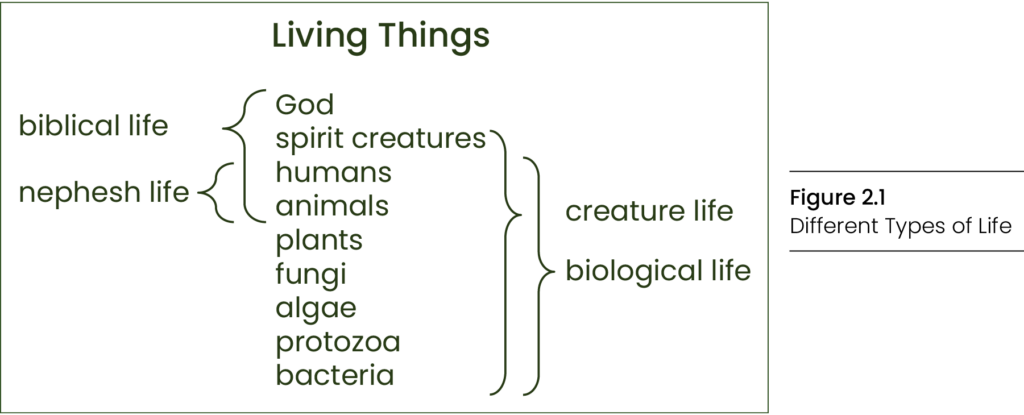
Plants, then, not only seem to lack nephesh or soul life, but they seem to lack anything at all that the Bible refers to as life. Consequently, what might be called biblical life—or that which is considered ‘life’ in the Bible—is possessed by God, spirit creatures, humans, and animals, but it is not possessed by plants. Nephesh life, since it is possessed by animals and humans, but not God and spirit creatures, would then be a type or subset of biblical life. Other things, like fungi, protozoa, algae, and bacteria are not specifically mentioned in Scripture. However, their similarity with plants would suggest they, like plants, do not possess biblical life.
Biological Life
God and spirit creatures are not studied by biologists because they are not physical beings. This suggests a limitation of biology. Biology cannot study all beings that possess life. On the other hand, biologists study and consider living a number of things that may not be living as the Bible uses the term (e.g. bacteria, protozoa, algae, fungi, and plants). This text will refer to all being studied by biologists (humans, animals, plants, fungi, algae, protozoa, bacteria) as organisms, and the type of life possessed by organisms will be referred to as biological life.
Even More Types of Life
A summary of the different types of life we have considered is illustrated in Figure 2.1. Since biblical life, creature life, nephesh life, and biological life are not the same, but do overlap, it is likely that there are a number of different types of life and that biblical, creature, nephesh, and biological life are different categories of life—each including multiple, distinct types of life. Different types of spirit creatures, different types of animals (I Cor. 15:39), different types of microorganisms, and different types of plants may each contain distinct types of life.