

History 1: American
-
How To Teach American History3 Steps
-
Lesson 1: Orientation10 Steps
-
1.1—Introduction & Note-taking (16 min video)
-
1.1—Read Table of Contents
-
1.2—Why School? Why the Humanities? (8 min video)
-
1.2—Read J.R.R Tolkien Quote
-
1.3—Why History? (10 min video)
-
1.3—Read Psalm 78
-
1.4—Good Quotes & Our Roadmap (11 min video)
-
1.4—Read Quotes & Write Essay
-
1.5—Readings, Assignments, Exams, Portfolios, & Projects (8 min video)
-
1.6–Start Portfolio (10 min video)
-
1.1—Introduction & Note-taking (16 min video)
-
Lesson 2: The Banner of the Sun (Meso-America)13 Steps
-
2.1—The Principle (14 min video)
-
2.1—Read Genesis 4 & 5
-
2.2—The Olmec & Maya (15 min video)
-
2.2—Read the Popol Vuh
-
2.3—The Aztec (12 min video)
-
2.3—Read Conquest of New Spain
-
2.4—The Inca (8 min video)
-
2.4—Read Incan Myths
-
2.5—The Spanish Conquest (8 min video)
-
2.5—Lesson 2 Portfolio
-
2.5—Lesson 2 Exam
-
2.6—Project 1: Colonial Map of the Americas (7 min video)
-
2.6—Choose Map & Begin Research
-
2.1—The Principle (14 min video)
-
Lesson 3: Brave New World (The Early Explorers)11 Steps
-
3.1—The Principle (12 min video)
-
3.1—Read Columbus' Dedication
-
3.2—The Myths & Legends (15 min video)
-
3.2—Read the Legend of Madoc of Wales
-
3.3—The Evidences (8 min video)
-
3.3—Read the Accounts of Vineland
-
3.4—Christopher Columbus, Part 1 (10 min video)
-
3.4—Read The Book of Prophecies
-
3.5—Christopher Columbus, Part 2 (9 min video)
-
3.5—Lesson 3 Portfolio
-
3.5—Lesson 3 Exam
-
3.1—The Principle (12 min video)
-
Lesson 4: The Colossus of Empire (The Colonies)11 Steps
-
4.1—The Principle (10 min video)
-
4.1—Progressive Map of European Colonies
-
4.2—Navigational Instruments (12 min video)
-
4.2—Sketch Marine Chronometer
-
4.3—The Portuguese Colonies (12 min video)
-
4.3—Read Vespucci's Voyage Account
-
4.4—The Spanish Colonies (13 min video)
-
4.4—Read de Soto Letter
-
4.5—The French Colonies & the Missions (6 min video)
-
4.5—Lesson 4 Portfolio
-
4.5—Lesson 4 Exam
-
4.1—The Principle (10 min video)
-
Lesson 5: Stability & Change (The Reformational Colonies)11 Steps
-
5.1—The Principle (10 min video)
-
5.1—Read Kuyper Quote
-
5.2—The Huguenot & Dutch Reformed Colonies (12 min video)
-
5.2—Create Map of New Amsterdam
-
5.3—The First English Attempts: Cabot, Drake, & Roanoke (10 min video)
-
5.3—Read Mayflower Compact
-
5.4—The English Colonies of Jamestown & Plymouth (14 min video)
-
5.4—Read Five Kernals of Corn
-
5.5—The English Colonies of Maryland & Georgia (7 min video)
-
5.5—Lesson 5 Portfolio
-
5.5—Lesson 5 Exam
-
5.1—The Principle (10 min video)
-
Lesson 6: A City Upon A Hill (The Puritans)12 Steps
-
6.1—The Principle (12 min video)
-
6.1—Read A Model of Charity
-
6.2—What is a Puritan? (14 min video)
-
6.2—Read Signs of Living to Please God
-
6.3—Five Puritan Values (12 min video)
-
6.3—Read A Father's Resolutions
-
6.4—Puritan Heroes: Winthrop, the Bradstreets, & Eliot (13 min video)
-
6.4—Read Anne Bradstreet Poems
-
6.5—Cotton Mather (14 min video)
-
6.5—Lesson 6 Portfolio
-
6.5—Lesson 6 Exam
-
6.6—Map Project Finished
-
6.1—The Principle (12 min video)
-
Lesson 7: A Foreign War at Home (Wars of Control)11 Steps
-
7.1—The Principle (8 min video)
-
7.1—Read Chapter 1 of "The Last of the Mohicans"
-
7.2—The Back Story (7 min video)
-
7.2—Read William Camden
-
7.3—Wars (13 min video)
-
7.3—Read "The Battle of La Prairie"
-
7.4—And More Wars (12 min video)
-
7.4—Read "Ticonderoga"
-
7.5—Quebec and the American Experience (8 min video)
-
7.5—Lesson 7 Portfolio
-
7.5—Lesson 7 Exam
-
7.1—The Principle (8 min video)
-
Lesson 8: Grace, the Founder of Liberty (The Great Awakening)14 Steps
-
8.1—The Principle (9 min video)
-
8.1—Read Revelation 21
-
8.2—Sleeping Dead Man (11 min video)
-
8.2—Research William Hogarth
-
8.3—The Awakeners: Freylinghuysen, Tennent, and Edwards (15 min video)
-
8.3—Read Jonathan Edwards
-
8.3—Extra Credit "Sinners in the Hands..."
-
8.4—George Whitefield, Part I (16 min video)
-
8.4—Read Whitefield Sermon
-
8.5—George Whitefield, Part 2 (7 min video)
-
8.5—Lesson 8 Portfolio
-
8.5—Lesson 8 Exam
-
8.6—Project 2: Costumed Speech (7 min video)
-
8.6—Choose Speaker & Speech for Costumed Speech Project
-
8.1—The Principle (9 min video)
-
Lesson 9: Fathers of Independence (Adams, Franklin, Witherspoon, & Henry)11 Steps
-
9.1—The Principle (10 min video)
-
9.1—Read Rights of the Colonists
-
9.2—Samuel Adams (15 min video)
-
9.2—Read Divine Source of Liberty
-
9.3—Benjamin Franklin (12 min video)
-
9.3—Recreate an Invention of Benjamin Franklin
-
9.4—John Witherspoon (8 min video)
-
9.4—Read John Witherspoon
-
9.5–Patrick Henry (11 min video)
-
9.5—Lesson 9 Portfolio
-
9.5—Lesson 9 Exam
-
9.1—The Principle (10 min video)
-
Lesson 10: Liberty or Death (The Declaration of Independence)11 Steps
-
10.1—The Principle (14 min video)
-
10.1—Read Liberty or Death
-
10.2—Narrative of Dates 1 (12 min video)
-
10.2—Read Benjamin Franklin
-
10.3—Narrative of Dates 2 (14 min video)
-
10.3—Read Paul Revere's Ride
-
10.4—Narrative of Dates 3 (12 min video)
-
10.4—Read the Declaration of Independence
-
10.5—The Declaration of Independence (11 min video)
-
10.5—Lesson 10 Portfolio
-
10.5—Lesson 10 Exam
-
10.1—The Principle (14 min video)
-
Lesson 11: Awesome Providence (The War of Independence 1)11 Steps
-
11.1—The Principle (9 min video)
-
11.1—Read Scripture
-
11.2—The Black Regiment (12 min video)
-
11.2—Read Sermon Given Before Battle of Kings Mountain
-
11.3—A Tale of Two Armies (14 min video)
-
11.3—Read George Washington Letter
-
11.4—1776, Part 1 (9 min video)
-
11.4—Read David Ramsay Selection
-
11.5—1776, Part 2 (8 min video)
-
11.5—Lesson 11 Portfolio
-
11.5—Lesson 11 Exam
-
11.1—The Principle (9 min video)
-
Lesson 12: Awesome Providence (The War of Independence 2)11 Steps
-
12.1—The Principle (12 min video)
-
12.1—Read "Nathan Hale"
-
12.2—Saratoga (11 min video)
-
12.2—Read "Bennington"
-
12.3—Valley Forge & Benedict Arnold (11 min video)
-
12.3—Read "Valley Forge"
-
12.4—Nathaniel Greene, George Rogers Clark, & Yorktown (11 min video)
-
12.4—Read "The Vow of Washington"
-
12.5—Forgotten Founders (8 min video)
-
12.5—Lesson 12 Portfolio
-
12.5—Lesson 12 Exam
-
12.1—The Principle (12 min video)
-
Lesson 13: A More Perfect Union (The Constitution)12 Steps
-
13.1—The Principle (9 min video)
-
13.1—Read the Articles of Confederation
-
13.2—Precedents & Problems (14 min video)
-
13.2—Read Article l of the Constitution
-
13.3—Parties & Articles (9 min video)
-
13.3—Read Articles ll-Vll of the Constitution
-
13.4—Convention & Constitution (11 min video)
-
13.4—Read The Bill of Rights
-
13.5—Rights & Ratification (5 min video)
-
13.5—Lesson 13 Portfolio
-
13.5—Lesson 13 Exam
-
13.6—Give Costumed Speech
-
13.1—The Principle (9 min video)
-
Lesson 14: Federal Headship (George Washington)11 Steps
-
14.1—The Principle (9 min video)
-
14.1—Read The Vow of Washington
-
14.2—American Joshua (13 min video)
-
14.2—Read Selection by George Washington
-
14.3—American Cincinnatus (14 min video)
-
14.3—Read Washington's First Inaugural Address
-
14.4—Washington’s Lieutenants (10 min video)
-
14.4—Read Washington's Farewell Address
-
14.5—Federal Headship (8 min video)
-
14.5—Lesson 14 Portfolio
-
14.5—Lesson 14 Exam
-
14.1—The Principle (9 min video)
-
Lesson 15: How Good & Pleasant It Is (Adams & Jefferson)14 Steps
-
15.1—The Principle (6 min video)
-
15.1—Read Daniel Webster
-
15.2—John Adams (13 min video)
-
15.2—Read Abigail Adams
-
15.2—Extra Credit: Read John Adams
-
15.3—Thomas Jefferson (14 min video)
-
15.3—Sketch Monticello
-
15.4—The Presidencies (14 min video)
-
15.4—Read "Letter to President Thomas Jefferson"
-
15.5—The Reconciliation (5 min video)
-
15.5—Lesson 15 Portfolio
-
15.5—Lesson 15 Exam
-
15.6—Project 3: Research and Thesis Paper (12 min video)
-
15.6—Choose Thesis Paper Topic & Begin Research
-
15.1—The Principle (6 min video)
-
Lesson 16: Manifest Destiny (Settlers, Explorers, & War)11 Steps
-
16.1—The Principle (14 min video)
-
16.1—Read de Tocqueville
-
16.2—Settlers (13 min video)
-
16.2—Read The Winning of the West
-
16.3—Explorers (13 min video)
-
16.3—Sketch Lewis Journal Entry
-
16.4—The War of 1812, Part 1 (12 min video)
-
16.4—Read The Cruise of the Wasp
-
16.5—The War of 1812, Part 2 (8 min video)
-
16.5—Lesson 16 Portfolio
-
16.5—Lesson 16 Exam
-
16.1—The Principle (14 min video)
-
Lesson 17: Word & Deed (John Quincy Adams & Andrew Jackson)12 Steps
-
17.1—The Principle (7 min video)
-
17.1—Read Scripture
-
17.2—John Quincy Adams (14 min video)
-
17.2—Read John Quincy Adams
-
17.3—Andrew Jackson, Part 1 (14 min video)
-
17.3—Read Jackson's National Bank Veto Speech
-
17.4—Andrew Jackson, Part 2 (7 min video)
-
17.4—Read the Appeal of the Cherokee Nation
-
17.5—The Trail of Tears (5 min video)
-
17.5—Lesson 17 Portfolio
-
17.5—Lesson 17 Exam
-
17.6—Thesis Outline Finished
-
17.1—The Principle (7 min video)
-
Lesson 18: The Original United Nations (Expansion of the Early U.S.)11 Steps
-
18.1—The Principle (8 min video)
-
18.1—Read Democracy in America Selection
-
18.2—Land (11 min video)
-
18.2—Read William Gilpin Quote
-
18.3—Technology, Communication, & Transportation (16 min video)
-
18.3—Read Erie Canal Journal Entries
-
18.4—Texas & The Mexican War (14 min video)
-
18.4—Read The Defense of the Alamo
-
18.5—Oregon, California, & The 11 Nations (9 min video)
-
18.5—Lesson 18 Portfolio
-
18.5—Lesson 18 Exam
-
18.1—The Principle (8 min video)
-
Lesson 19: Idols of Mercy (Revivals, Counterfeits, & Art)12 Steps
-
19.1—The Principle (9 min video)
-
19.1—Read de Tocqueville Selection
-
19.2—The Digression of Ideas (14 min video)
-
19.2—Read Democracy in America Selection
-
19.3—Revivals & Revivalism (14 min video)
-
19.3—Read Nettleton Sermon
-
19.4—Heresies & Cults (10 min video)
-
19.4—Read "Self-Reliance" Selection
-
19.5—Art & Literature (12 min video)
-
19.5—Lesson 19 Portfolio
-
19.5—Lesson 19 Exam
-
19.6—Thesis Paper Finished
-
19.1—The Principle (9 min video)
-
Lesson 20: A House Divided 1 (The Age of Compromise & Divided Cultures)11 Steps
-
20.1—The Principle (12 min video)
-
20.1—Read "A House Divided"
-
20.2—The Missouri Compromise & Regional Distinctions (15 min video)
-
20.2—Read John C. Calhoun Selection
-
20.3—American Slavery (12 min video)
-
20.3—Read Slave Narratives
-
20.4—American Abolition (8 min video)
-
20.4—Read "On the Death of John Brown"
-
20.5—American Secessions (4 min video)
-
20.5—Lesson 20 Portfolio
-
20.5—Lesson 20 Exam
-
20.1—The Principle (12 min video)
-
Lesson 21: A House Divided 2 (Abraham Lincoln & Secession)13 Steps
-
21.1—The Unifiers (16 min video)
-
21.1—Read John C. Calhoun Selection
-
21.2—The 1850s (14 min video)
-
21.2—Read The Fugitive Slave Act
-
21.3—Abraham Lincoln: His Early Life (13 min video)
-
21.3—Read Abraham Lincoln Letter
-
21.4—Abraham Lincoln: His Political Worldview and the Election of 1860 (15 min video)
-
21.4—Read Lincoln's First Inaugural Address
-
21.5—Abraham Lincoln: His Faith (7 min video)
-
21.5—Lesson 21 Portfolio
-
21.5—Lesson 21 Exam
-
21.6—Project 4: The Hour Project (8 min video)
-
21.6—Choose “Hour Project” Goal
-
21.1—The Unifiers (16 min video)
-
Lesson 22: The Second War for Independence (The War Between the States 1)11 Steps
-
22.1—The Principle (9 min video)
-
22.1—Read Jefferson Davis' Inaugural Address
-
22.2—Overview & Fort Sumter (15 min video)
-
22.2—Read "How Men Die in Battle"
-
22.3—The Union Army (11 min video)
-
22.3—Read General McClellan Letter
-
22.4—The Confederate Army (10 min video)
-
22.4—Read Robert E. Lee Letters
-
22.5—The First Battle of Bull Run (6 min video)
-
22.5—Lesson 22 Portfolio
-
22.5—Lesson 22 Exam
-
22.1—The Principle (9 min video)
-
Lesson 23: Brother Against Brother (The War Between the States 2)11 Steps
-
23.1—The Principle (14 min video)
-
23.1—Read "Music in the Camp"
-
23.2—The Shades of Blue and Grey: Anaconda to Shenandoah (16 min video)
-
23.2—Read Poems About Stonewall Jackson
-
23.3—Antietam to Gettysburg (14 min video)
-
23.3—Read Abraham Lincoln
-
23.4—Forrest to Atlanta (10 min video)
-
23.4—Read General Sherman Letter
-
23.5—Appomattox to the End (5 min video)
-
23.5—Read Sherman Letter to General Halleck (in place of exam)
-
23.5—Lesson 23 Portfolio
-
23.1—The Principle (14 min video)
-
Lesson 24: The Lost Cause (Reconstruction)11 Steps
-
24.1—The Principle (11 min video)
-
24.1—Read "Lee in the Mountains"
-
24.2—Reconciliation, Assassination, & Johnson (11 min video)
-
24.2—Read "O Captain, My Captain"
-
24.3—Black Codes & Amendments (12 min video)
-
24.3—Read Thaddeus Stevens Speech
-
24.4—Reconstruction Act to President Grant (15 min video)
-
24.4—Read Constitutional Amendments & Hill Speech
-
24.5—The End of Reconstruction (7 min video)
-
24.5—Lesson 24 Portfolio
-
24.5—Lesson 24 Exam
-
24.1—The Principle (11 min video)
-
Lesson 25: A New Normal (The West, Immigration, & Robber Barons)11 Steps
-
25.1—The Principle (11 min video)
-
25.1—Read Introduction to Christianity and Liberalism
-
25.2—Passive Leaders & Powerful Ideas (17 min video)
-
25.2—Read Christianity and the Social Crisis
-
25.3—The Wild, Wild West (13 min video)
-
25.3—Read The Frontier in American History
-
25.4—Immigrants, Cities, & Railroads (17 min video)
-
25.4—Read The Road to Business Success
-
25.5—Steel & Oil (6 min video)
-
25.5—Lesson 25 Portfolio
-
25.5—Lesson 25 Exam
-
25.1—The Principle (11 min video)
-
Lesson 26: Theology As Biography (Theodore Roosevelt & Booker T. Washington)12 Steps
-
26.1—The Principle (12 min video)
-
26.1—Read The Struggle for an Education
-
26.2—TR: From His Early Life to His Return (14 min video)
-
26.2—Read Character and Success
-
26.3—TR: From the Rough Riders to the Amazon (16 min video)
-
26.3—Read The Man With the Muck Rake
-
26.4—Booker T: His Early Life to Hampton Roads (11 min video)
-
26.4—Read Atlanta Exposition Address
-
26.5—Booker T: The Tuskegee Institute & Lost Causes (6 min video)
-
26.5—Lesson 26 Essay (in place of exam)
-
26.5—Lesson 26 Portfolio
-
26.6—Hour Project Finished
-
26.1—The Principle (12 min video)
Get Started

There are a number of different elements to this curriculum that make it quite unique.
Once you see how everything works together, however, it should be fairly easy to teach.
The class is designed to fill two semesters. It covers 26 Lessons with the goal of completing one Lesson per week. Each Lesson is broken down into five different lectures (approximately 10 minutes each) with associated readings or assignments.
Each day, plan on scheduling approx. 10 minutes for the video and 10 minutes for the daily reading and questions.
Each week, budget approximately 20 minutes for the exam, and another 20 for the Lesson’s Portfolio entry. These elements can be modified to suit the age and frame of your student. For example, parents of middle school students might remove the daily readings to concentrate on the Portfolio, and integrate the Exam questions as a summary of the applicable lesson video.
You can assign one lecture a day or you can go through two or more lectures in one day. Your student will be the best gauge as to how much he or she can effectively cover at one time.
One Lesson is normally completed per week. Use the included chart (sample) to mark off what has been finished. Only exams, essays, and projects are scored.
If an Assignment asks one or more questions, these are meant to be considered by the student as he or she does the reading. You can also use these questions as a way to discuss the lesson with your student after the lesson and readings are complete.
Grading is one of the most challenging tasks of the humanities teacher. Grading a simple question such as, “In what year did Columbus discover the Americas?” is easy and straightforward. But grading the question, “What motivated Columbus to set sail?” is rather complex because it requires a careful consideration on the part of the teacher over a multitude of answers. The reason for this is that history is an art within the humanities which, as Harry L. Lewis once said, “teach[es] us what it means to be human.” A multitude of answers can therefore be given since different students have different perspectives.
That said, specific information is always provided in these history lessons. Furthermore, a principle, or main idea, is always referred to. The real art of the humanities teacher is to evaluate a student’s knowledge, understanding, and wisdom of a given subject. Such an evaluation looks like this:
- Knowledge—Does the student know key people, places, dates, and events?
- Understanding—Does the student understand how the idea or action of one person or people resulted in a specific event or culture later in History?
- Wisdom—Can the student apply this knowledge and understanding to other periods of history, other subjects, and even his or her personal life?
When I grade my students according to this rubric, I ask several key questions of the student’s answers. First, I want to know, “Do the answers of the student show a work ethic matching their current maturity in the discipline of history?” No one starts in the same place as another. Every individual brings a unique experience and perspective to the table. Thus, not all students have the same abilities as each other when answering questions or performing tasks. However, all students can be graded against themselves, week-by-week. The goal is to see consistent improvement in students’ answers exam-by-exam and to evaluate their level of work ethic when they apply themselves to an assigned task or question.
Secondly, “How thorough is the answer of the student?” Consider whether or not the student has answered all parts of the question. Determine whether or not all required information has been included. Ask the student to augment answers that are vague or lacking in detail. After all, history is about specifics and is typically told through a narrative. Students should be able to retell the stories of the past as this is the key to enjoying history.
Thirdly, “Does the student show an ability to interact with and explain the principle through their answers?” This is the most difficult part to grade but is also the most rewarding. In the work of my students, I am constantly searching for an understanding of how Biblical principles work, whatever the subject, because this is the key to wisdom. In the answers of your students, you want to ask whether or not they understand the main idea and have connected it to the specific info contained in the lesson. If they have, encourage them to apply this in other areas of their life. If they have not, review the material or discuss it from a fresh perspective.
History is an art and cannot be mastered in any single lifetime. It is an art akin to a spiritual discipline since no matter the number of times we have heard a certain tale or learned a specific verse, we must return to it again and again lest we become forgetful and slip into the void of unfaithfulness. History teaches us to remember God’s mighty deeds and to hope because an infinite and merciful Yahweh has already ordained our days—past, present, and future.
The readings have been carefully selected to create a fully-orbed program. These readings consist of speeches, first-hand accounts, sermons, letters, poems, and historical narratives. Each reading is also accompanied by a question or two about the selection in order to prompt a student’s critical thinking in each reading. Some readings are easily accessible to students of 6th-10th grades and some are not. Therefore, it is up to the discretion of the teacher whether or not to assign a reading, to assign only part of the reading, or to coach a student through part of the reading.
Please remember that these materials are designed to give a student a full course in American history and may be seen as either core materials or supplemental.
The name of the game in portfolios is craftsmanship. When I grade portfolios, I am primarily interested in whether or not the student has created a visual scrapbook of high quality work and whether or not they have done this work consistently. Also, I only grade the weekly (or per lesson) portfolios on a quarterly basis. I find this to be a good measure and encouragement of a student’s personal responsibility and time management. To be precise, here is my rubric for grading portfolios.
The “Year Long Portfolio” (taken from this blog article)
“If we receive one question about our history courses it’s usually about the year long portfolio. Since it’s a student’s creation most parents are uncertain how it “should” look. In short, the portfolio is a unique scrapbook. The portfolio offers students a chance to retell history lessons using their own gifts and talents. If a student is an artist, writer, poet, composer, crafter, graphic designer, etc. they can create their own portfolio in such a way to represent their skill while keeping them engaged in the course.
Thankfully our friends at Half A Hundred Acre Wood have shared an excellent post, The Making of a History Portfolio and explained how they created their history portfolio.”
Like portfolios, projects require diligence and craftsmanship. While each project is different, they can all be graded upon these two virtues. Additionally, I also require classroom presentations of my students for each project which contribute to their overall grade. This may or may not be feasible in your situation but is highly encouraged.
Here are my grading rubrics for each project in the American History year.
Calculating High School Credit
HSLDA recommends spending approximately 150 hours on a subject to qualify for high school credit.
This is how Dave Raymond’s classes generally break down to achieve that credit. Some students will spend more time in some areas and some will spend less, but there is clearly enough different types of work to qualify for full high school credit.
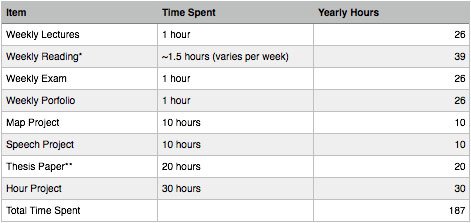
The reader includes 372 pages of original historical materials. It increases in length as the year progresses. For example, Lessons in the first semester comprise 150 pages while those in the second comprise 222 pages. If additional reading is desired for older students, we include recommendations for that.
If a parent desires to do two or more thesis papers for older students, that is perfectly acceptable and will only increase the amount of time spent in the class.